
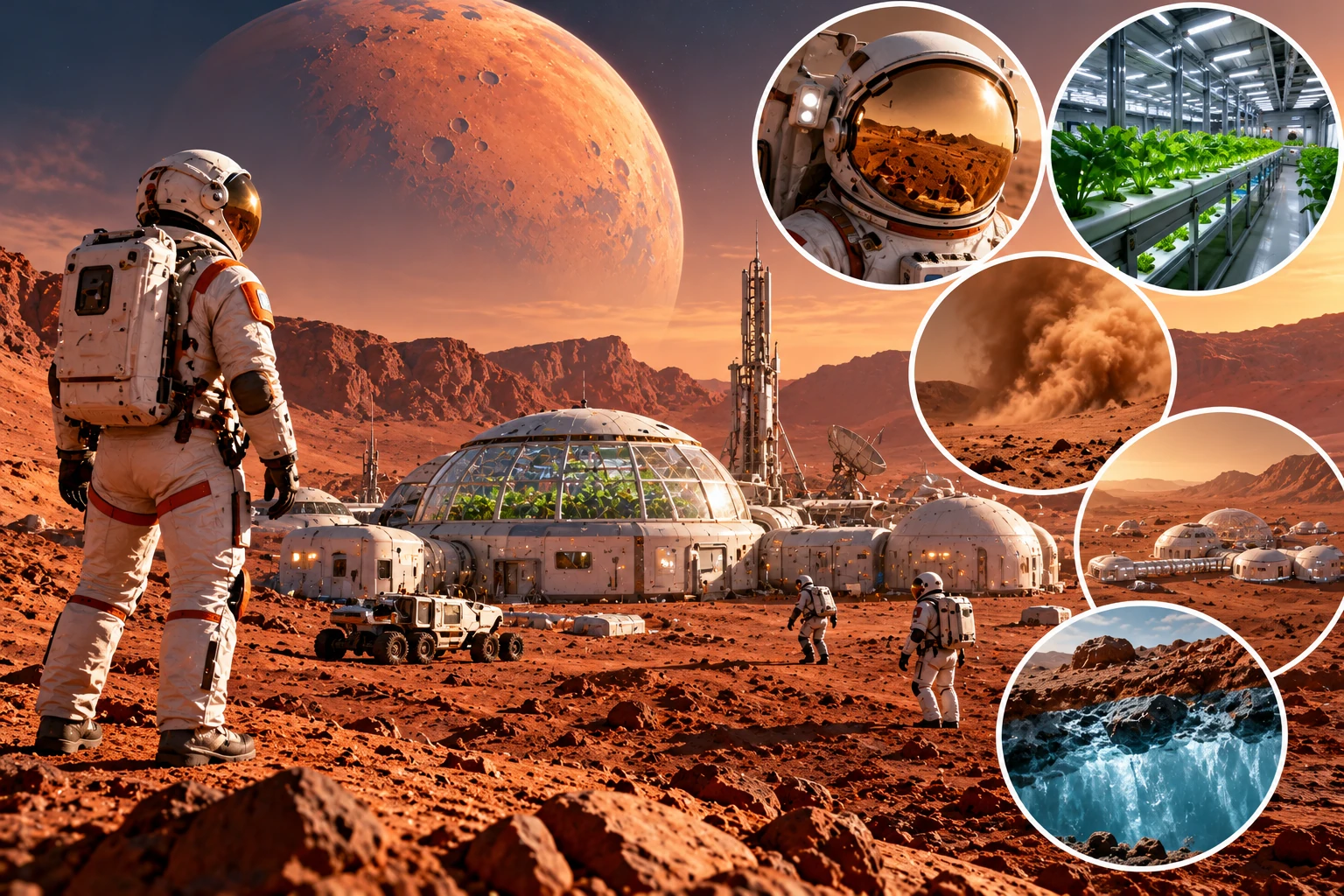
For centuries, Mars has captured human imagination as a possible destination for exploration and settlement. The Red Planet has seasons, polar ice deposits, enormous volcanoes, and landscapes that resemble some of Earth’s deserts. Modern spacecraft and robotic rovers have revealed valuable information about its environment, making the possibility of human exploration more realistic than ever.
However, establishing a permanent human settlement on Mars would be an extraordinary engineering and scientific challenge. Before people can live there for extended periods, researchers must solve several problems involving radiation, food, water, transportation, and human health.
1. Surviving the Thin Martian Atmosphere
Mars has an extremely thin atmosphere composed primarily of carbon dioxide. Unlike Earth, it does not provide enough oxygen for humans to breathe, and its low atmospheric pressure makes an unprotected human presence impossible.
Future settlements would need pressurized living spaces, reliable oxygen supplies, and spacesuits designed for outdoor activities.
Scientists are investigating technologies that could produce oxygen from Martian resources. NASA’s MOXIE experiment, carried aboard the Perseverance rover, successfully demonstrated oxygen production from carbon dioxide in the Martian atmosphere. Scaling such technology for human settlements would require much larger systems.
2. Protecting Astronauts From Radiation
Earth’s atmosphere and magnetic field help protect life from harmful space radiation. Mars lacks a comparable global magnetic field and has a much thinner atmosphere, leaving its surface more exposed to radiation from space.
Long-term exposure can increase the risk of cancer and other health problems. Radiation may also affect the nervous system and reproductive health.
Scientists are investigating shielding materials, underground habitats, protective structures covered with Martian soil, and improved radiation monitoring systems. Reliable protection will be essential for both astronauts and future settlers.
3. Finding and Managing Water
Water is essential for drinking, hygiene, food production, and many industrial processes. Although liquid water is unstable on much of the Martian surface today, scientists have identified substantial water ice in certain regions.
Future missions may need to extract ice from the ground and process it into usable water. This would reduce the amount of water that must be transported from Earth.
However, extracting water safely and efficiently remains a significant engineering challenge. Equipment would need to function in extremely cold conditions while managing dust, energy demands, and possible contaminants.
4. Growing Food on Mars
Transporting all food from Earth would be expensive and logistically difficult. A long-term settlement would therefore benefit from growing at least some food locally.
Mars presents several obstacles. Its soil is not ready for direct agricultural use, temperatures are harsh, and surface radiation is high. Researchers are studying controlled-environment farming, hydroponics, artificial lighting, and nutrient recycling.
A successful Martian farm would need to produce dependable harvests while using limited water, energy, and growing space. It would also need to provide sufficient nutritional variety for a healthy diet.
5. Dealing With Extreme Temperatures
Mars is generally much colder than Earth. Temperatures vary substantially depending on location, season, and time of day, and some regions can become extremely cold.
Habitats would need strong insulation, reliable heating, and systems that continue operating during dust storms or equipment failures.
Outdoor spacesuits would also need to protect astronauts against cold temperatures, low pressure, and abrasive dust. Engineers must ensure that these systems remain reliable even after repeated use.
6. Building Reliable Habitats
A permanent settlement would require safe sleeping areas, medical facilities, laboratories, food production systems, and equipment storage.
Transporting construction materials from Earth would be expensive, so researchers are exploring ways to use local resources. Possible approaches include producing building materials from Martian soil or constructing protected habitats partially underground.
Habitats must also withstand pressure differences, temperature fluctuations, dust intrusion, and mechanical failures. Reliable backup systems would be essential because emergency assistance from Earth could take months to arrive.
7. Managing Human Health and Isolation
Long missions would expose astronauts to reduced gravity, restricted living spaces, and prolonged separation from family and friends.
Reduced gravity may contribute to muscle loss, bone weakening, and changes in cardiovascular function. Isolation and confinement may also affect sleep, concentration, relationships, and mental well-being.
Exercise equipment, medical monitoring, structured routines, recreation, and psychological support would be important parts of any settlement.
Scientists must also understand how the human body responds to living on Mars for years rather than months.
8. Making the Journey to Mars Safer
Traveling to Mars requires a long journey through space, with transit times depending on spacecraft design, propulsion, and planetary positions. A conventional mission may take several months each way.
During the journey, astronauts would need reliable life-support systems, radiation protection, food supplies, and equipment capable of operating far from Earth.
Communication delays would also complicate operations. Because signals cannot travel faster than light, conversations between Mars and Earth may involve delays of several minutes each way, depending on their distance apart.
9. Producing Enough Energy
A Martian settlement would require energy for heating, lighting, water processing, communications, food production, and scientific equipment.
Solar panels could provide power, but dust accumulation and storms may reduce their output. Nuclear power systems could offer a more consistent energy supply, although they would require careful engineering and safety planning.
A practical settlement would likely need dependable energy generation, storage, and backup systems to avoid dangerous interruptions.
10. Financing and Maintaining a Permanent Settlement
Establishing a human settlement on Mars would require enormous financial investment, international cooperation, advanced technology, and years of testing.
Every system would need to be maintainable using limited spare parts and resources. Medical emergencies, equipment failures, and supply shortages could have serious consequences.
Before permanent settlement becomes realistic, robotic missions and crewed exploration programs will need to demonstrate that essential technologies work reliably under Martian conditions.
When Could Humans Live on Mars?
Human missions to Mars remain a long-term goal for space agencies and private aerospace companies. However, the timeline for a permanent settlement is uncertain.
Sending astronauts for a temporary exploration mission is considerably different from establishing a self-sustaining community. A settlement would need dependable food production, water extraction, power generation, medical care, and protection against environmental hazards.
Even after the first astronauts arrive, creating a permanent and largely self-sufficient settlement could take decades of development.