
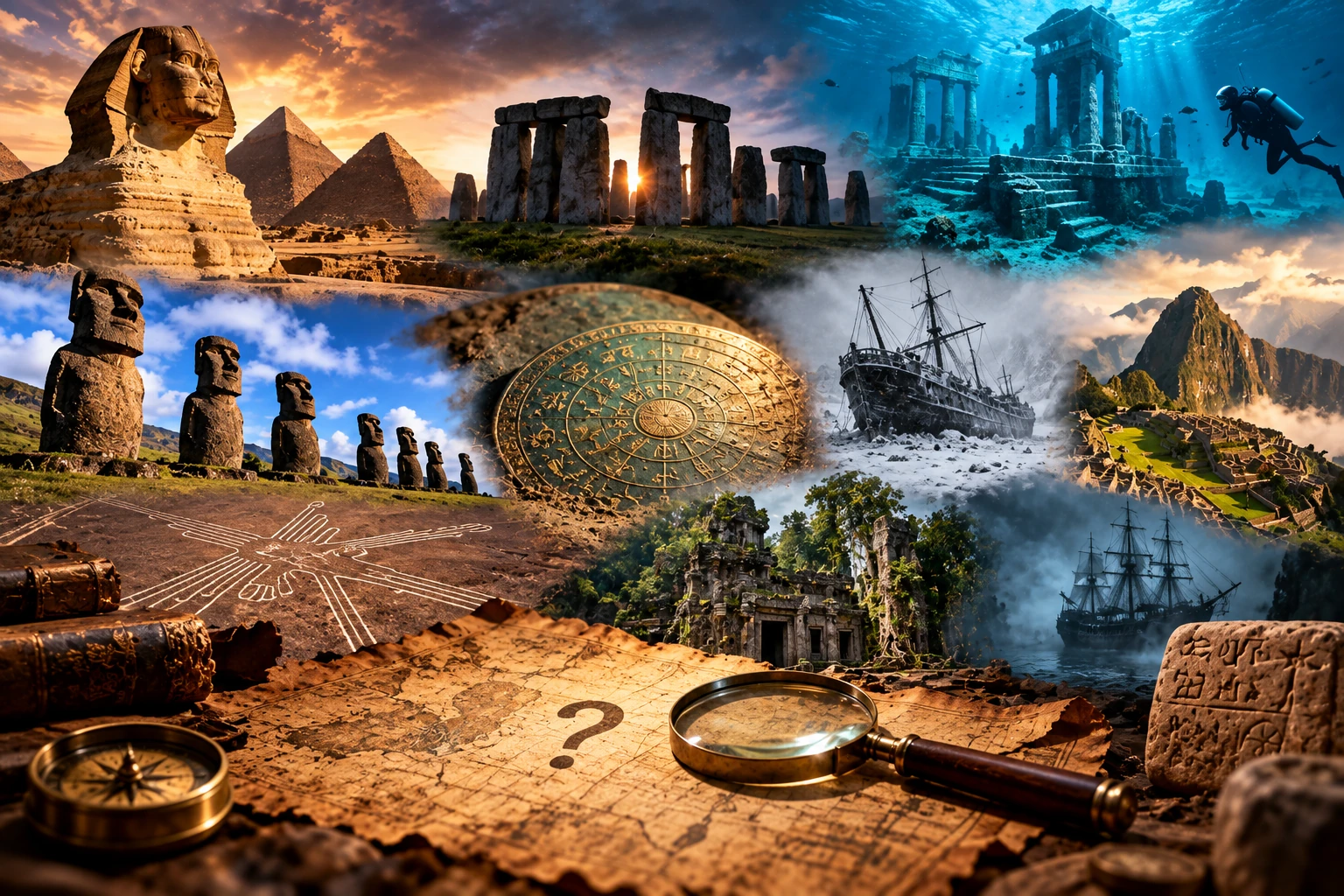
History is filled with remarkable discoveries, forgotten societies, unexplained disappearances, and ancient structures that continue to challenge researchers. Archaeologists and historians have uncovered evidence that helps explain many historical events, yet some questions remain unresolved because records are incomplete or multiple explanations fit the available evidence. These mysteries encourage researchers to investigate the past and reconsider what is known about human civilization.
1. The Identity of Jack the Ripper
In 1888, a series of brutal murders in London’s Whitechapel district created widespread fear. The killer became known as Jack the Ripper, but investigators never conclusively identified the person responsible.
Numerous suspects have been proposed over the years. However, incomplete police records, unreliable witness accounts, and uncertainty surrounding some historical claims have prevented a definitive solution.
2. The Purpose of Stonehenge
Stonehenge, located in southern England, is one of the world’s most recognizable prehistoric monuments. Its construction involved transporting and arranging enormous stones thousands of years ago.
Archaeological evidence connects the monument with prehistoric ceremonial practices and astronomical alignments. However, its precise purposes, the full meaning of its construction phases, and the beliefs associated with it remain subjects of investigation.
3. The Lost Colony of Roanoke
In the late sixteenth century, English settlers established a colony on Roanoke Island in present-day North Carolina. When a later expedition returned, the settlement had been abandoned.
The word “CROATOAN” was discovered carved into a wooden post, but no definitive explanation of the colonists’ fate has been established. They may have joined Indigenous communities, relocated elsewhere, or faced other hardships.
4. The Voynich Manuscript
The Voynich Manuscript is an illustrated manuscript believed to date to the early fifteenth century. Its text uses an unfamiliar writing system that has resisted widely accepted decipherment.
The manuscript contains illustrations of plants, astronomical-looking diagrams, and unusual human figures. Researchers disagree about the language, purpose, and meaning of its text, although some have proposed that it may be encoded, invented, or otherwise structured language.
5. The Fate of Amelia Earhart
Aviation pioneer Amelia Earhart disappeared in 1937 while attempting to fly around the world with navigator Fred Noonan.
Despite extensive searches and later investigations, the exact location of their aircraft and the circumstances of their disappearance have not been conclusively established. Several theories suggest a crash into the ocean or a landing on a remote island, but definitive evidence remains lacking.
6. The Construction of the Great Pyramid of Giza
The Great Pyramid was built during the reign of Pharaoh Khufu around the twenty-sixth century BCE. Archaeological research has revealed evidence about workers, construction materials, and transportation methods.
Nevertheless, the precise combination of engineering techniques used to raise and position every block remains debated. Its impressive scale continues to attract research into ancient Egyptian organization, mathematics, and construction practices.
7. The Antikythera Mechanism
Discovered in a shipwreck near the Greek island of Antikythera, this ancient mechanical device contains intricate bronze gears.
Dating to approximately the second or first century BCE, it could model astronomical cycles and predict certain celestial events. Although researchers understand many of its functions, questions remain about its full capabilities, how widely similar devices were used, and how its technology developed.
8. The Purpose of the Nazca Lines
The Nazca Lines in Peru consist of enormous designs etched into the desert surface. They include animals, geometric shapes, and long straight lines created by ancient communities.
Researchers have proposed religious, ceremonial, astronomical, and water-related interpretations. Some explanations have stronger archaeological support than others, but the exact purpose of every design remains uncertain.
9. The Collapse of the Bronze Age
Around 1200 BCE, several major societies across the eastern Mediterranean experienced destruction, political collapse, or major disruption.
Warfare, drought, earthquakes, migration, and trade breakdown have all been suggested as contributing factors. Researchers continue to examine how these pressures interacted rather than assuming one single catastrophe explains the entire period.
10. The Identity of the Sea Peoples
Ancient Egyptian inscriptions describe groups known collectively as the Sea Peoples, who were involved in conflicts during the Late Bronze Age.
Their movements have been connected with widespread regional instability. However, their precise origins, ethnic identities, and relationships with other migrating populations remain disputed.
11. The Disappearance of the Roanoke Settlement
The fate of the Roanoke colonists remains one of the most enduring mysteries in American colonial history. Although the possibility of migration or integration with Indigenous communities is often discussed, direct evidence identifying the settlers’ eventual location remains inconclusive.
Archaeological investigations continue to explore the region for clues.
12. The Purpose of Easter Island’s Moai
The monumental moai statues of Rapa Nui were created by the island’s Indigenous Polynesian inhabitants. Researchers have learned much about their cultural significance, quarrying, and transportation.
However, questions remain about some construction methods, the organization of labor, and the roles of individual statues within different communities. Older claims that the entire population suddenly collapsed are also increasingly reconsidered in light of archaeological evidence and the impacts of later colonial contact.
13. The Identity of the Man in the Iron Mask
A mysterious prisoner held in France during the seventeenth century became famous because he was required to conceal his identity.
Historical records confirm that the prisoner existed, but his true identity has been debated for centuries. Proposed explanations range from a relatively obscure political prisoner to a person connected with powerful figures at the French court.
14. The Origin of the Etruscans
The Etruscans developed a sophisticated civilization in central Italy before Roman expansion. Their language, artwork, religious practices, and political institutions influenced early Roman culture.
Although archaeology and genetic research have improved understanding of their history, questions remain about the development of Etruscan identity and the relationships between migration, local populations, and cultural exchange.
15. The Lost City of Atlantis
Atlantis is described in ancient Greek philosophical writings by Plato. According to his account, it was a powerful island civilization that eventually disappeared beneath the sea.
No convincing archaeological evidence establishes Atlantis as the real advanced civilization described in the story. Many scholars interpret the account as a philosophical narrative rather than a reliable historical record, although it continues to inspire debate and speculation.